
Reviewed by Dr. Mithun Panchal, Plastic, Cosmetic & Hair Transplant Surgeon , M.B.B.S ,M.S ( Gen Surg ), M.Ch ( Plastic Surgery) — Essence Aesthetic Clinic, Vadodara
Chances are, if you’ve looked into PRP treatment, someone’s told you it can fix thinning hair, tired-looking skin, or a cranky knee. It’s not that simple what it does, and how well it works, depends on what’s being treated and who’s sitting in the chair.
PRP stands for platelet-rich plasma. It’s made from your own blood, spun down to concentrate the platelets above their normal levels. Those platelets carry proteins and growth factors tied to tissue repair, and once prepared, the plasma gets injected into the treatment area.
So what’s PRP actually good for? The honest answer is more layered than most marketing pages let on.
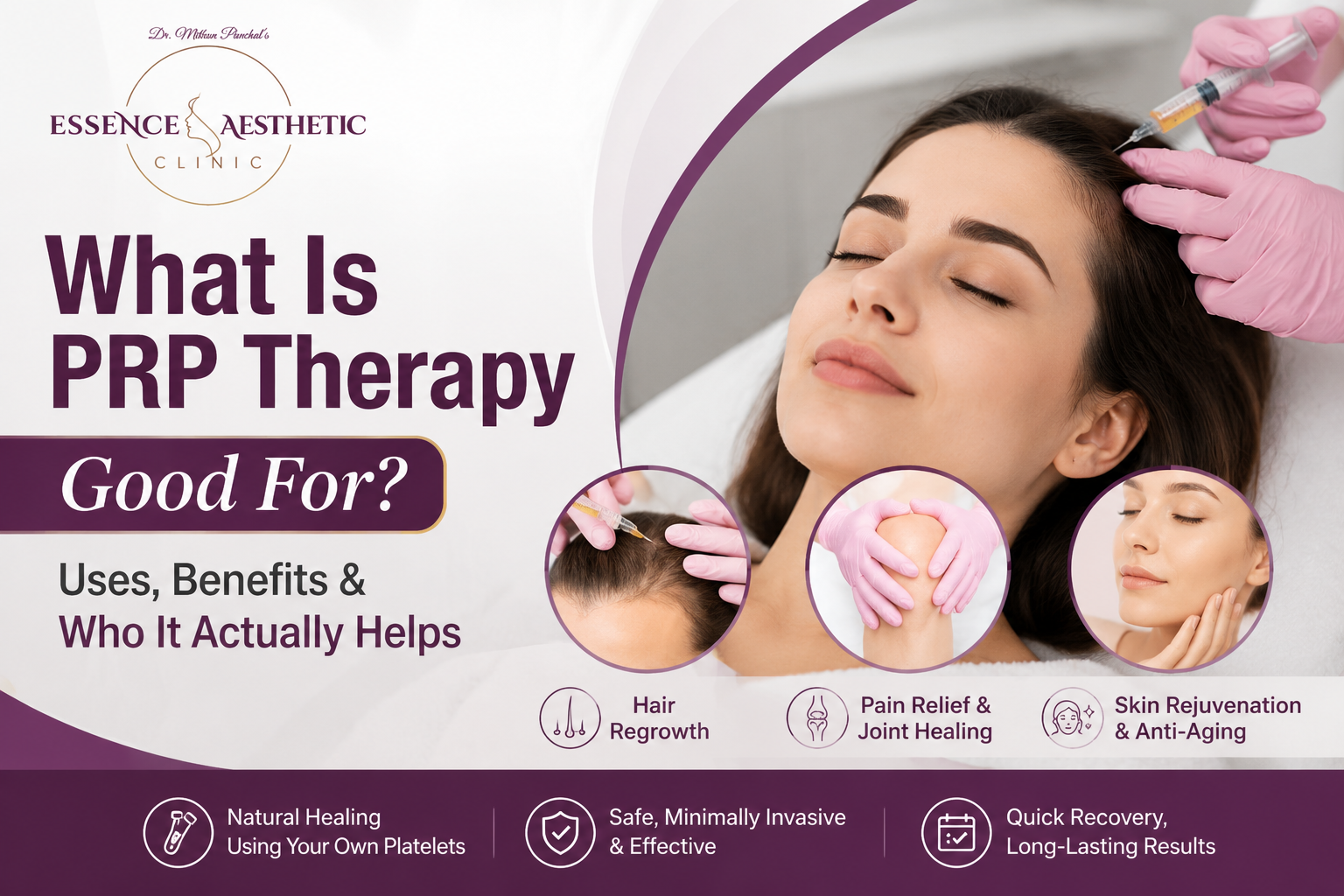
What Is PRP Therapy ?
This procedure takes a small blood sample and turns it into a concentrated, platelet-rich solution. Blood is drawn from your arm, spun in a centrifuge to separate it into layers, and the platelet-rich portion is injected into the target area, scalp, skin, joint, wherever it’s needed.
The theory: platelets carry growth factors and signalling proteins tied to the body’s repair process. Concentrate them, deliver them somewhere specific, and the hope is you nudge healing along. That doesn’t mean PRP fixes everything or works the same for everyone; the evidence shifts depending on what you’re treating.
What Is PRP Therapy Commonly Used For?
PRP shows up in a handful of medical and cosmetic settings right now. Some have solid research behind them; others are still catching up.
1. Hair Loss
This is probably the use most people know, especially for androgenetic alopecia, or pattern hair loss.
Research points to PRP improving hair density in people with this condition. A systematic review of controlled trials found a measurable increase in density compared to saline injections, though researchers flagged the overall evidence as low quality due to inconsistent studies and bias risk.
That matters, because PRP shouldn’t be sold as a guaranteed fix. It tends to work better on follicles that are still active but shrinking, rather than areas where hair’s gone for good. The Indian Association of Dermatologists, Venereologists and Leprologists has backed PRP for select patients, pointing to certain early-to-moderate Norwood-Hamilton grades as a reasonable fit. PRP is best thought of as one piece of a broader plan, not a stand-in for everything else.
2. Skin Rejuvenation
PRP treatment also has a place in cosmetic dermatology, where the goal usually isn’t treating a disease but improving how skin looks and feels. Dermatologists reach for it with concerns like fine lines, uneven texture, and signs of aging sometimes injected alone, sometimes paired with microneedling.
PRP isn’t a facelift. Changes tend to happen slowly, and results vary person to person, so it’s worth discussing what’s realistic with a qualified dermatologist first.
3. Certain Musculoskeletal Problems
Sports medicine and orthopaedics have taken an interest in PRP too, studying it for tendon, ligament and joint issues, knee osteoarthritis being one of the more researched examples.
Findings here are encouraging but not consistent. A 2026 AAPM&R guidance statement noted PRP use for knee osteoarthritis is growing, but the field needs stronger, dose-dependent randomised trials to say exactly how well it works. PRP might help pain and function for some patients, but it isn’t something that reverses arthritis or rebuilds a seriously damaged joint.
What Are the Potential Benefits of PRP Therapy?
- For hair loss: better density, support for weakening follicles, and a minimally invasive approach using your own blood.
- For cosmetic skin work: improved texture, a fresher look, softer fine lines, and support for the skin’s own repair process.
- For select joint issues: less pain, better function, and support for the body’s natural healing response.
But there’s a real gap between potential benefit and guaranteed result. Outcomes are shaped by platelet concentration, preparation method, injection technique, session count, and the patient which makes it genuinely hard to predict how any one person will respond.
Who Is a Good Candidate and Who Isn’t?
PRP is worth discussing with a doctor when there’s a clear diagnosis and some evidence backing it for that specific condition. For hair loss, someone with early or moderate pattern hair loss is generally a better candidate than someone with long-standing bald patches, since PRP works with biological processes already happening rather than growing new follicles. For joint problems, the diagnosis, severity, past treatments, age and overall health all factor in. For cosmetic use, it comes down to the person’s skin concerns and suitability.
Diagnosis needs to come first, always hair shedding alone can stem from nutritional gaps, hormonal shifts, illness, stress or autoimmune issues, and treating the wrong cause won’t fix the actual problem.
PRP treatment also isn’t automatically right for everyone. If you have a condition or take medication affecting bleeding, platelet function or healing, a doctor may steer you toward other options first, and PRP tends to be less useful once tissue damage is advanced. A proper consultation matters when a good clinician reviews your history and goals before recommending PRP at all.
Is PRP Therapy Painful?
There’s blood collection and injections involved, so some discomfort should be expected. For scalp treatments, people often describe brief stinging or pressure during injections, with tenderness afterward how it feels depending on the area, technique, and pain tolerance. A topical or local anaesthetic may be used to take the edge off.
How Many Sessions Are Needed, and How Long Until Results?
There’s no single schedule for every condition. For androgenetic alopecia, IADVL guidance points to roughly three to five sessions spaced about a month apart. Other uses call for a different rhythm, part of why it’s worth being cautious of clinics promising a fixed session count before assessing your situation.
Results take time too. Hair loss improvement is usually judged over months, not days. Skin changes unfold gradually, and joint pain timelines shift depending on the condition. Judge PRP over a reasonable stretch of time, not right after the needle comes out.
Are There Risks or Side Effects?
Since PRP uses your own blood, allergic reaction to the plasma itself is unlikely. It’s still an injection-based procedure though, with possible effects like pain or tenderness at the site, swelling, bruising, soreness, occasional bleeding, and, though uncommon with proper sterile technique, infection.
Risk shifts depending on where the injection happens and how it’s carried out, picking a qualified provider matters just as much as deciding whether PRP is right for you.
PRP Therapy : What It Can and Cannot Do
It’s easy to fall into thinking PRP is some kind of natural cure-all. The reality is more grounded.
PRP treatment may help with things like supporting hair growth in select cases of pattern hair loss, improving how skin looks in certain ways, easing symptoms or improving function for some musculoskeletal issues, and giving people a minimally invasive option that uses their own blood.
PRP shouldn’t be expected to: guarantee hair regrowth, reverse every cause of hair loss, permanently erase wrinkles, rebuild a damaged joint, replace established treatments, or produce the same result in every patient.
Conclusion
PRP isn’t a miracle treatment. It isn’t just a cosmetic fad either. What it is, is a legitimate medical procedure where results really hinge on the condition being treated and the person going through it.
Pattern hair loss tends to respond best in the research so far, with some patients seeing better density. Skin rejuvenation can bring improvements too, though nothing dramatic. Joint problems are the trickiest: the science is promising in spots but still working itself out.
The question worth asking isn’t whether PRP is “good” as some blanket statement. It’s whether it actually fits your problem, and that’s something worth discussing with a qualified dermatologist at Essence Aesthetic, an orthopaedic specialist, or another appropriately trained medical professional.