
Reviewed by Dr. Mithun Panchal, Plastic, Cosmetic & Hair Transplant Surgeon , M.B.B.S ,M.S ( Gen Surg ), M.Ch ( Plastic Surgery) — Essence Aesthetic Clinic, Vadodara
A mole on your face or body may seem like a minor skin concern, especially when it catches on clothing or gets in the way of shaving. A quick online search will turn up plenty of ways to remove moles at home, often with simple remedies that promise fast results. However, not every DIY solution is safe for your skin. Before you try to remove a mole yourself, it’s important to understand the risks, including burns, scarring, infection and a delayed diagnosis of a suspicious growth. This guide explains why common home remedies can be harmful, which safer options dermatologists recommend, and when a professional should examine a mole.
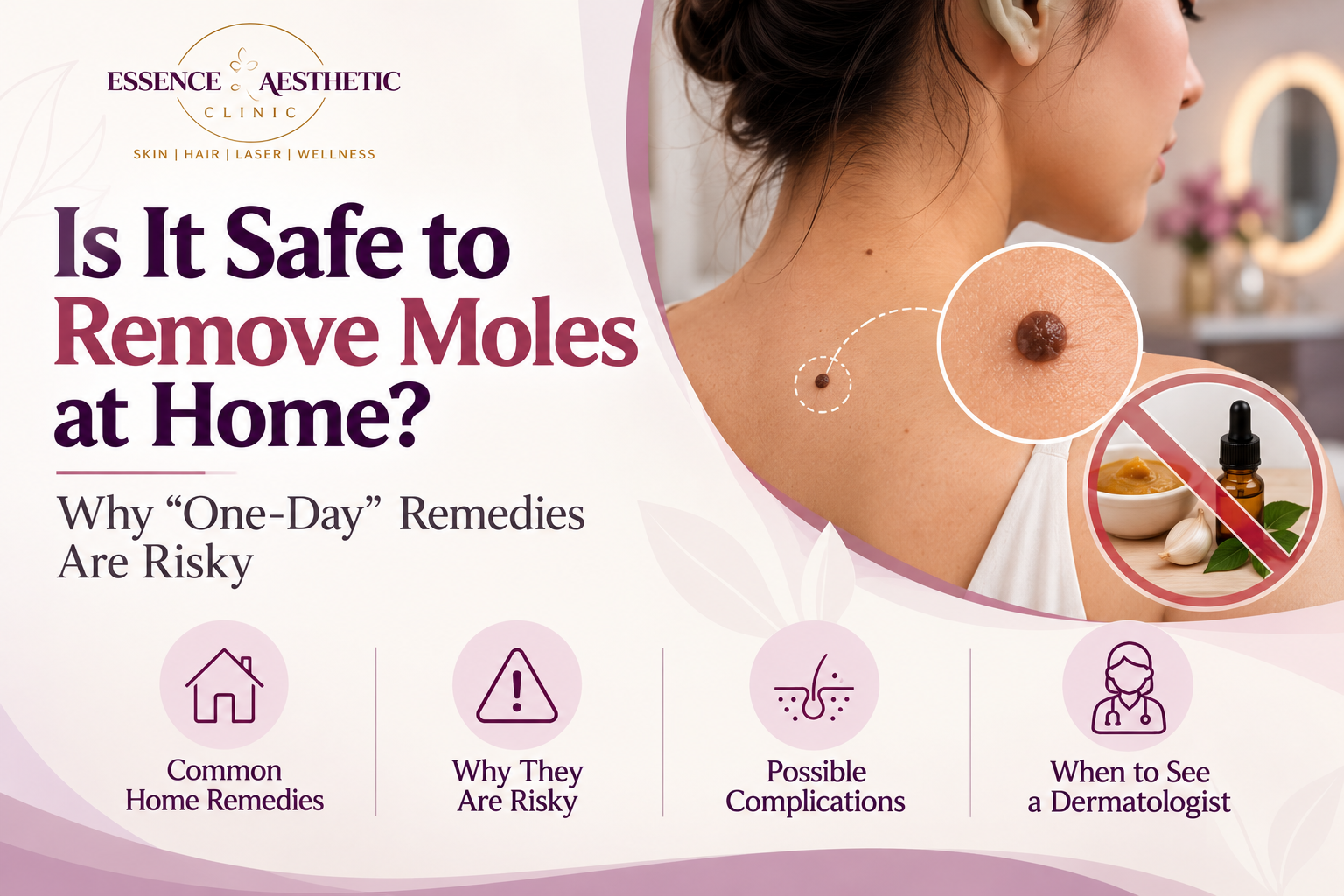
What Are Moles, and Why Do They Appear?
A mole, known medically as a nevus, is a common skin growth. It forms when pigment-producing cells called melanocytes cluster together instead of spreading evenly through the skin. Most people have several, and they can appear anywhere on the body.
A typical mole is one colour (often brown, but it can be tan, pink, blue or skin-toned), round or oval, flat or slightly raised, and stable from month to month. Moles can differ in size, shape and colour, even on the same person. Some also change slowly over the years, and a few fade.
The complication is that other growths can resemble moles, including some skin cancers such as melanoma. However, looking at a spot is rarely enough to tell them apart. That’s why dermatologists use magnified examination and, when needed, a biopsy. In other words, if you can’t be certain what a growth is, you can’t be certain what you’re destroying.
Can You Remove Moles at Home Naturally?
No. There is no reliable scientific evidence that household remedies can safely and completely remove a true mole, so trying to remove moles at home with DIY treatments is risky. The American Academy of Dermatology (AAD) notes that online do-it-yourself tips are not proven to work and that some may be dangerous.
The usual suspects include lemon juice, apple cider vinegar, garlic, baking soda pastes and abrasive scrubs. Anyone hoping to remove moles naturally with these is really relying on irritation. Acidic or abrasive substances can inflame or burn the skin until a scab forms. As a result, the spot may look lighter afterwards. That is injury, not removal, and the deeper pigment cells may remain.
The realistic outcomes are skin irritation, chemical burns, pigment changes and scarring. It also helps to separate two things. General skincare, such as cleansing, moisturising and wearing sunscreen, is healthy for skin. Attempting to destroy or cut away a mole, by contrast, is a different matter entirely.
Why Are “One-Day” Remedies to Remove Moles at Home Risky?
Quick-fix promises tend to skip over what happens when you damage skin deliberately. These are the main concerns.
Skin Irritation and Chemical Burns
Nobody designed lemon juice or vinegar to treat pigmented lesions. Left on for hours, or covered with a bandage, they can cause redness, stinging, blistering and burns. Mole-removal creams and pens sold online raise similar worries. In fact, the US Food and Drug Administration (FDA) has warned that it has not approved any over-the-counter products for mole removal.
Permanent Scarring and Pigment Changes
Burned or cut skin heals with scar tissue. The result can be a raised mark, a pitted area, or a patch that is lighter or darker than the surrounding skin, which may later need professional pigmentation treatment. In some cases, the scar ends up more noticeable than the mole ever was.
Bleeding, Infection and Delayed Healing
Cutting or scraping a mole with scissors, a razor or a needle can cause significant bleeding. In addition, tools that aren’t sterile can introduce bacteria, and a wound on the face or in a friction-prone area may heal slowly.
Delayed Diagnosis of Serious Skin Conditions
This is the least visible risk. When you remove moles at home, nothing goes to a laboratory. Dermatologists stress that you can’t tell by looking whether a mole is cancerous, and a growth that looks like a mole could be melanoma. Most moles are harmless. Still, a scabbed or burned spot can hide changes that a clinician would want to see.
Incomplete Removal and Possible Regrowth
Surface treatments often destroy only the top layer. If pigment cells remain deeper down, the mole can return, sometimes as an irregular patch that is harder to assess than the original.
Is It Safe to Remove Moles From the Face Naturally?
No, and the face is where the stakes feel highest. Anyone looking to remove moles from face naturally is dealing with skin that is visible every day. Around the eyes, nose and lips, that skin is also relatively thin and delicate. Consequently, a burn, cut or scrape there can leave marks that are hard to hide.
Harsh ingredients, scraping, cutting and burning all carry the risks described above, with higher cosmetic consequences. So, if you want to remove moles from face naturally, see a dermatologist first. They can identify the growth and explore suitable removal options without risking unnecessary skin damage. For a closer look at those options, see our guide on how to remove moles from the face permanently.
It’s worth keeping expectations realistic, though. Professional removal can also leave a scar or a change in pigment, and no one can promise a scar-free result. The difference is that a dermatologist uses sterile equipment, matches the technique to the location, and can send the removed tissue for testing when appropriate.
What Is the Safest Way to Remove a Mole?
The safest route is to see a qualified skin specialist rather than trying to remove moles at home. The right approach depends on the mole’s type, location, depth and appearance. Many moles, in fact, don’t need removing at all. Options a dermatologist may consider include:
- Clinical assessment and biopsy: The doctor examines the growth, often with a handheld magnifying device, and takes a sample for laboratory testing if anything looks concerning.
- Surgical excision: The dermatologist cuts out the whole mole, and sometimes a small margin of surrounding skin, then usually closes the wound with stitches. Doctors typically use this for suspicious or deeper growths, and it leaves a fine-line scar.
- Shave removal: For selected raised growths, a blade removes the mole at skin level. Stitches are usually unnecessary, although a flat mark may remain and pigment can sometimes return.
Not every procedure suits every patient. Your dermatologist will explain which option fits your skin and your reasons for wanting removal, whether that’s a medical concern, repeated irritation or cosmetic preference.
How to Recognise a Mole That Needs Medical Attention
Dermatologists use the ABCDE guide to flag spots that deserve a closer look.
|
Letter |
What it means |
What to look for |
|
A |
Asymmetry |
One half doesn’t match the other half |
|
B |
Border |
Edges that are ragged, blurred or irregular |
|
C |
Colour |
Several shades, or colours such as black, blue, red or white within one spot |
|
D |
Diameter |
Larger than about 6 mm (a pencil eraser), although melanomas can be smaller |
|
E |
Evolving |
Any change in size, shape, colour or height over time |
Other signs worth reporting include itching, bleeding, crusting, a sore that won’t heal, a mole that looks different from your others, or a new and unusual growth. None of these automatically means cancer, but each one warrants a professional assessment. The AAD advises making an appointment promptly if a spot shows any of the ABCDEs, and notes that doctors can treat melanoma very effectively when they find it early.
Above all, if a mole looks suspicious, don’t try to remove it yourself. Doing so can destroy the very tissue a pathologist would need to examine.
What Can You Do Instead of Trying to Remove Moles at Home?
The most useful home habits are protective rather than destructive:
- Use gentle skincare: Cleanse, moisturise and avoid scrubbing or picking at moles.
- Protect your skin from the sun: Use a broad-spectrum sunscreen with SPF 30 or higher, reapply it as directed, and add shade, hats and protective clothing.
- Check your skin regularly: Get to know your moles so you notice new or changing ones. Dated photographs can help you track changes, although they don’t replace a medical evaluation.
- Avoid unapproved products: Skip mole-removal creams, pens, acids and DIY freezing or cutting devices.
Whether you try to remove moles naturally or with a shop-bought product, nothing on the shelf can make a true mole disappear. Therefore, if a mole bothers you, the answer is a conversation with a dermatologist, not a stronger remedy.
Conclusion
Trying to remove moles at home can look harmless, but the evidence points the other way. Irritation, burns, scarring and pigment changes are real possibilities, and a home attempt can also delay the diagnosis of something that needs attention. Quick results aren’t worth that trade.
If a mole worries you, whether because of how it looks or how it behaves, book a professional assessment first. A dermatologist can tell you whether you need removal, which method suits you and what to expect from healing. In the meantime, protecting your skin from the sun and watching for changes are simple ways to look after both your skin’s health and its appearance.